5 Exterior Insulation Options (7 Minutes of BS)
Key Highlights
- Exterior insulation reduces thermal bridging and condensation risks, especially when applied during enclosure upgrades or siding replacements.
- Retrofitting with exterior insulation improves air tightness, controls indoor air quality, and enhances resilience against extreme weather events.
- Moisture sensors and proper drainage are critical in preventing moisture buildup within wall assemblies during retrofits.
- Stepwise retrofitting begins with increasing wall insulation and window upgrades, followed by mechanical system adjustments for optimal efficiency.
- Case studies at Fanshaw College demonstrate the effectiveness of different insulation materials and systems, with monitoring confirming moisture control and durability.
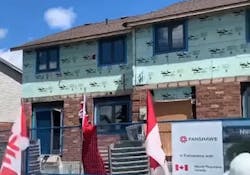



Today, we are joined by Jonathan Smegal, an engineer with RDH Building Science in Waterloo, Ontario. Mr Smegal discusses the benefits of exterior insulation, then walks us through a recent study of five exterior insulation systems.
TRANSCRIPT:
"There's a massive market for deep energy retrofits, adding insulation, making buildings more. Energy efficient."
This is Seven Minutes of BS (Building Science with a Beat). I'm Dan Morrison, editor of ProTradeCraft, and that was Jonathan Smegel, an engineer with RDH. Jonathan is talking about the opportunity of energy retrofits.
It's staring us in the face every day. It's the houses in our neighborhoods. The energy bills we're surprised by every month. And the indoor air quality that we experience inside those homes. In the past, deep energy retrofits were a thing that energy nerds talked about.
"Solar panels are the badge of honor that you put on an efficient building!"
...was proclaimed by one such energy nerd at the Westford Symposium on Building Science about a decade ago. It was like the energy nerd's battle cry.
Once you pay for insulation, the price never goes up
It still makes sense to lower energy use because energy is never gonna get cheaper every winter. You need to buy warm air to put in your house and cool air for the summer. But if you buy insulation, you can reduce the amount of warmth you need to buy every winter.
And once you pay for that insulation, the price never goes up. But the payoff equation isn't quite that simple. Rarely do energy retrofits pay for themselves as quickly as say a widescreen tv.
The main reason to talk about retrofits is that there's so many existing buildings, um, both in Canada and the United States.
I mean, there's 125 million occupied housing units in the United States according to 2022 survey, and many of them are quite old. Some of them don't even have insulation at all. So there's a massive market for deep energy retrofits, adding insulation, making buildings more energy efficient.
It's more of a long-term investment.
Energy costs go up every year
You'll save some percentage on your energy bills, and while that percentage probably won't change over time, the value of that percentage will because heat doesn't get cheaper. Energy costs typically go up about 4% a year. But a lot higher than that lately.
I agree with you completely. It's very difficult to justify a deep retrofit on the grounds of payback and the owner saving money anywhere in the near future.
For those of you keeping score, that's lower energy bills in the short term. In the midterm, it's increasingly lower energy bills because energy keeps getting more expensive and in the long term, the house is more valuable to tomorrow's home buyer. There's also an insurance policy aspect, resilience. In the event of a long-term power outage, the home will hold its heat longer in winter and stay cooler in summer.
Resilient houses save lives
And in a world where people die in their homes every year from heat waves and ice storms, resilience is an insurance policy that feels worth it. The other short-term and midterm benefit, which is hard to put a dollar value on, is indoor air quality. Occupant Health,
Usually, the cost for the retrofit is quite high, and the savings are relatively modest.
But what it does do, what the, you know, some of the biggest effects are, are comfort, which you really can't put a price on. Uh, you know, occupancy comfort is better. Um, you have more control, like you said, over the temperature swing within your house. So you tend to have less highs and lows, more balanced temperature.
Which also plays to comfort. The resale value of the home usually will go up quite a bit, and that's usually a longer term. Goal. If you wanna sell your home after you've done a deep energy retrofit, you will get more money for it. In many markets, usually as part of a retrofit, we do air tightening, increase the air tightness of the the home, which means we have less uncontrolled air leakage, which does make the interior environment typically a little bit [00:04:00] healthier.
Air movement is not optional—but its pathway is
The thing about air leakage is that air moves between the inside of a house and the outside. You can either choose the path or leave it up to chance. You can provide filtered and tempered air to the living space, or you can let it leak in along with radon from the basement or filter it through dead mice in the wall cavities.
That's not healthy air; people put it into their lungs.
And so when you do a retrofit and you add intentional ventilation, whether it be an HRV or ERV. You have a control over where your fresh air is coming from, where it's being distributed to, and it's filtered, so it's a little bit healthier for the occupants.
A step by step path to energy efficiency
You don't need to go deep into an energy retrofit to get many of the benefits. There are steps.
The first step in a, in an energy retrofit would be actually opening up the walls, adding more insulation to the enclosure system itself, increasing the R value and improving the windows. Um, that's kind of the minimum and usually the first step people do in a retrofit because once you do that, once you increase the r value and improve the windows, you really do reduce the energy load on the house.
And so when you reduce the energy load, then comes step two where you can improve the mechanical equipment and usually decrease the, the size of it because you don't have as big a cooling or heating load
Ideally, you'd do the insulation and window replacement before the heating equipment is due for replacement.
So you can buy smaller equipment when the current stuff ages out.
I think the one of the best times that people decide to do deep energy retrofits well that are more intrusive into their enclosure is when they're reaching the end of the service life of, uh, enclosure components. Or oftentimes people upgrade their enclosures because they just want a new look, or they're increasing value of their building, and so they are removing the, the siding or the exterior cladding, and that is the best time to do a, a deep energy retrofit because the best place to put insulation on your buildings on the exterior, you wanna wrap the, the exterior insulation continuously around the building.
It has the benefits of reducing thermal bridging of the structure and also reducing any potential condensation in colder climates. Inside the wall assembly.
Case study with five exterior insulation strategies
Speaking of retrofitting insulation on the outside of buildings, Jonathan's team at RDH helped analyze a study of five retrofits at Fanshaw College in London, Ontario.
Between Detroit and Niagara Falls, multiple insulation companies were invited to participate,
...and so there were five different insulation manufacturers that were involved. BASF, Rockwool DriveIt, Owens Corning, and then Plaster Fab InsulSpan. And they did five different strategies in doing the deep energy retrofits of the enclosure.
The five basements and attics were identically sealed using spray foam in the basements and air sealing and fluffy stuff in the attics. Air sealing is a critical component and byproduct of an energy retrofit.
On that note, when we improve the air tightness, there may or may not be intentional ventilation, and so sometimes we have to add an H-R-V-E-R-V to that space, and we did that in all the, all of the buildings that we did in the steep energy retrofit, they all got HRVs because previously they had all been kitchen and bathroom exhaust fans.
So they were needed, and they're student residences. So you, you, I mean you, if you've ever seen a student residence, it's very unpredictable in the moisture loads and the, the number of people and, and you know, odors and cooking and things like that. So we need ventilation in those buildings, obviously, uh, to keep the relative humidity down because it is a cold climate.
It's climate zone five or six right on the border. And so it is a cold climate. We are worried about condensation in this, uh, in this space. So. We got these five insulation manufacturers involved and they, they each did a different strategy. Uh, BSF had a combination [00:08:00] of spray foam from the exterior and neopore, which is EPS, insulation as the exterior continuous insulation.
Rockwool used a semi-rigid stone wool with a vapor permeable membrane on the OSB. Drive it did an EEA system and the, one of the advantages of the EEA system was that it can go right over the brick. They don't need to remove the brick. That could keep the brick there. It adds some mast to the wall. It also reduces what goes to the landfill.
Owens Corning had, uh, an XPS solution with taped XPS as the air tightness layer and plastic fat insul span had, uh, more of a nail based product. So they put up a, an air barrier layer, and then they put on, uh, laminated OSB to. EPS installation and then strapping was applied to that. In all cases, they used a drained or a rain screen approach.
They put strapping on the outside of every single assembly. And then they put vinyl siding up on top of that. And so we had a drained vented cavity behind the vinyl siding, which is generally best practice when it comes to these types of residential buildings.
RDH's role initially was to comment on the details that the architect had to work through with each of the five manufacturers.
And then RDH also installed enclosure monitoring systems in each of these buildings.
Moisture is an issue to plan for
Moisture sensors inside the wall, cavities,
...you know, usually the main concern is that. Interior leakage is gonna reach the back of the OSB, which is cold, condenses, rots, moisture accumulation, things like that. But in these systems, we tried to keep those moisture sensors in a similar location where if moisture were to get there, it would it be a problem
Because the outside insulation means that the wall sheathing is now on the inside.
And so sure enough, we've mounted it for a couple years now, and we have seen no elevated moisture contents in any of the wall assemblies. Uh, in any of the framing or in any of the air spaces with relative humidity,
And sure enough, there's no elevated moisture content or hot air here at seven minutes of bs.
I want to thank Jonathan Smigel, an engineer with RDH, for coming on and explaining it to us. In the next episode, Jonathan and I will discuss which systems we like the best.
In the meantime, don't forget you get paid for what you do and what you know. Now you know more.
Seven Minutes of BS is a production of Endeavor Business Media, a division of Endeavor B2B.