Mileseey S50 Green-Beam Laser Distance Measurer — Review
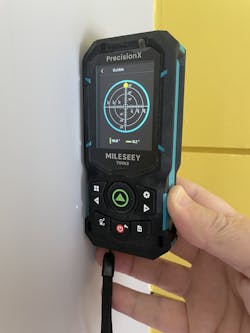
The Mileseey Tools S50 is positioned as a feature-rich, mid-range laser distance measurer that aims to bridge the gap between entry-level DIY tools and premium professional models. Its headline differentiator is a green-beam laser—marketed as significantly brighter than standard red beams—paired with long-range, tight accuracy claims, and a deep feature set that includes app connectivity and multiple reference points.
Design & build quality
The S50 feels purpose-built rather than gadgety. The housing is compact, with good button spacing and a 1-1/2-inch-by-2-inch display that seems perfectly readable without hunting for contrast. It does not feel like a toy, despite my 12-year-old inner self; my retired-carpenter-self reports that it feels like a tool. Power comes from two AA batteries, backed up by USB-C charging, so you’re not sidelined when rechargeables run low. It is reasonably resistant to dust and moisture (IP54 rating), so it should fare well on outdoor jobsites.
Accurate measurements
I used the S50 during interior trim and flooring work in an office remodel. In use, the laser distance measurements consistently matched real-world tape measurements to within 1/16 inch, as expected for a ±1/16-inch tool. While this is impressive, finish carpentry usually requires accuracy within 1/32 of an inch, so I see this more as an estimating tool than a "measure twice, cut once" finish carpentry tool.
While framers work in 1/8- and 1/4-inch increments, I just don't see this as taking the place of a standard tape measure any time soon. I can see, though, how beaming a laser would be 1,000 times faster than sliding a tape measure down a long wall plate to get a top plate measurement. Mounted to a tripod, you can beam to one edge of a roof, then to the other, to yield the length between the points. A few measurements like that, and the tool will pay for itself.
Inside my office, I used it to measure ceiling boards (I did a nickel-gap treatment rather than trying to (old) manhandle full sheets of drywall into place). Because I had drywall going on the walls later, the 1/16 inchvaruability was not an issue at all. In fact, I cut 1/4 inch from the numbers I beamed.
After the ceiling and walls were complete, I used <ileseet S50 to calculate how much flooring I'd need. To my surprise, the area function also feeds a perimeter measurement, so with only two button pushes, I learned how much flooring AND baseboard I'd need.

The tool finds perimeter AND area. My office is 11 ft. 5 in. by 10 ft. 10-11/32 in.; that makes the area 124.14 ft. The bonus measurement, which confused me at first, is the perimeter: how much baseboard I'd need.
Plumb and level reality checks
The built-in level function proved equally reliable and handy. I've been using the levels in my arsenal for decades and have never really checked whether they are still accurate. I am happy to report that a side-by-side check against my 6' 6" Stabila door-hanger level showed consistent agreement. This is good for a few reasons:
- The door-hangers level was a gift from my wife 25 years ago, when I was still a carpenter
- It shows that the Mileseey S50 is accurate (at least over the 5-inch section of wall you are checking.
- It means that my window installs are plumb and level.
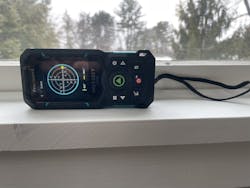
The window sill is level—almost a bit of a surprise considering an old 2-foot level was used to dial it in. When you consider how many degrees a little bit off level works out, it is remarkable that bubble levels are so accurate. My windowsill is .3 degrees away from perfection.
Highly visible beam
The green beam was easy to see indoors and held up well across a range of lighting conditions, reinforcing the visibility advantage cited in independent reviews. While I did not use it extensively outside (I intended to use it on a Building Resilience video shoot, but the shoot was deeply shortened by weather, so I did not break out the Mileseey).
I did take it outside and measure a couple of distances (from my back door to the shed (69 ft., 2-23/32 in.), from my front door to my neighbor's front door (98 ft., 9-5/8 in.). Though I did find it difficult to see the green beam at that distance, even though my shed was in the shadow. Perhaps with practice, I will get better.
Features & functionality
The S50’s spec list is long, but the features are more than box-checking. It supports 18 measurement modes, including area, volume, continuous measurement, indirect (Pythagorean), and point-to-point (P2P) functions. Multiple **reference points—front, back, tripod mount, and side-laser alignment—**make it adaptable to different measuring scenarios without mental gymnastics.
I did not download or sync the app, but the Mileseey S50 and the SmartLife app are Bluetooth-connected. The app allows measurements to be logged, backed up, and exported. This could be useful for an estimator working outside the office. For anyone documenting existing conditions or capturing dimensions during walkthroughs, this is a legitimate productivity gain rather than a novelty.
User experience
Ease of use is one of the S50’s quiet strengths. Navigation is intuitive enough that basic measurements don’t require cracking the manual, a point echoed by user feedback elsewhere. Buttons respond cleanly, the display communicates clearly, and the tool doesn’t fight you when switching modes or reference points.
Independent reviews reinforce this impression, noting that real-world accuracy closely matches that of traditional tape measures and that features like side-laser alignment and tripod reference are uncommon at this price point.
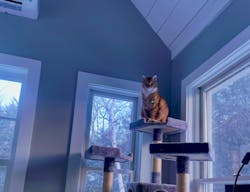
The cat test. The green beam shows up clearly against Timmy's orange fur, and according to the Mileseey S50, he is 8 feet, 1-5/32 inches away from my desk chair...
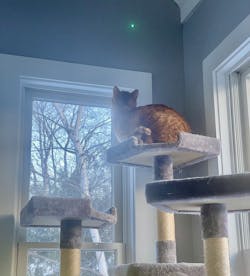
...and he is very interested in the laser.
Bottom line: #worthit
The Mileseey S50 is well-suited for remodelers, subcontractors, and serious DIYers who need reliable accuracy, strong laser visibility, and flexible measurement options—or who just don't want to keep climbing a ladder to hook a tape measure. Its performance, compact size, and dust/moisture resistance would earn it a place in my nailbags if I were still wearing them every day. At $129, it feels worth it for anyone doing repeat layout, estimating, or installation work. Especially if you have a cat.